
How To Identify Pump Type?
A Practical Guide for Industrial Buyers and Maintenance Engineers
In industrial and municipal fluid handling systems, selecting the right pump is critical to operational efficiency, energy cost, and long-term reliability. Yet many procurement teams and on-site engineers struggle to distinguish one pump type from another, especially when reviewing technical datasheets or inspecting installed equipment. This guide breaks down the key identification criteria and explains what each specification means for your application.
Start with the Operating Principle
The first and most fundamental classification is based on how the pump moves fluid. **Centrifugal pumps** use a rotating impeller to increase fluid velocity and convert it into pressure. They are the most common type in water supply, wastewater, and general industrial transfer. **Positive displacement pumps**, on the other hand, trap a fixed volume of fluid and force it through the discharge port—think gear pumps, screw pumps, and diaphragm pumps. These are preferred for viscous fluids, high-pressure dosing, and applications requiring precise flow rates.
A quick visual check: if the unit has a volute casing and an impeller inside, it is almost certainly centrifugal. If it features meshing gears, a flexible diaphragm, or a progressing screw, it falls into the positive displacement family.
Look at Construction and Installation Style
How a pump is mounted tells you a great deal about its intended service.
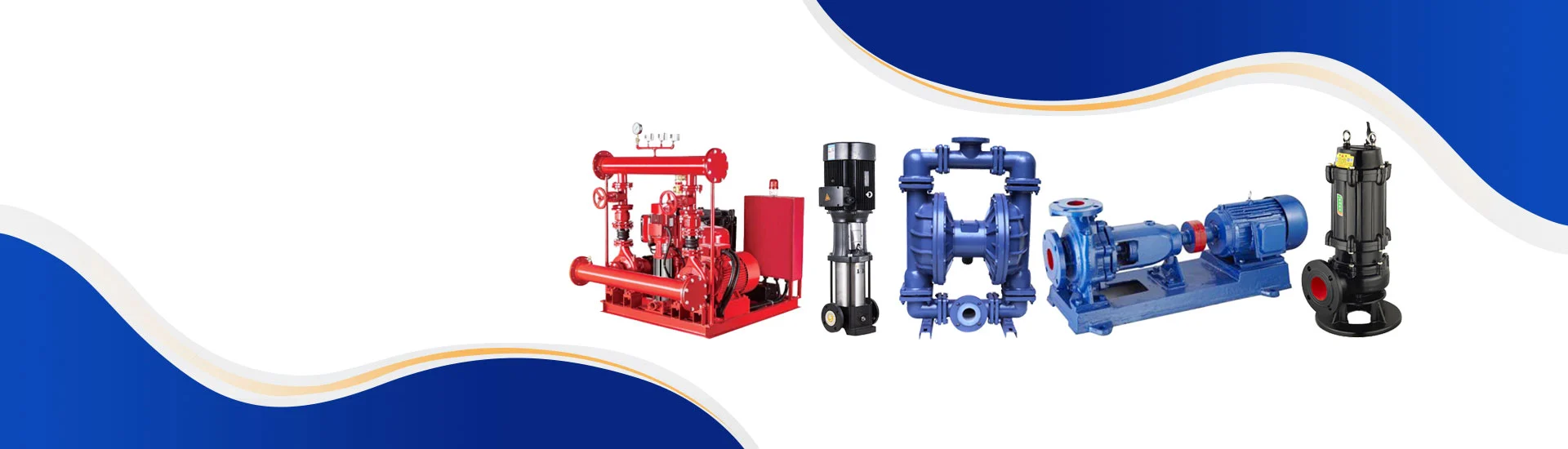
Submersible pumps are designed to operate fully submerged in the liquid they are pumping. They feature a hermetically sealed motor coupled directly to the pump body, with an IP68 protection rating and waterproof cable entry. These are standard in sewage sumps, drainage pits, and sludge handling tanks.
Surface-mounted or end-suction pumps sit above the fluid level and require priming before operation. They are easier to access for maintenance but need adequate suction head to avoid cavitation.
Vertical inline pumps are installed directly in the pipeline, saving floor space and commonly used in HVAC and water circulation systems.
Check the Impeller and Casing Design
Within centrifugal pumps, impeller style defines application suitability. Open or semi-open impellers handle liquids containing suspended solids, sludge, and fibrous material—hence their widespread use in wastewater and sewage pumps. Closed impellers deliver higher efficiency for clean water but clog easily with solids. Vortex or recessed impellers create a swirling action that passes solids without direct contact, making them ideal for heavily contaminated fluids.
Casing material also signals purpose. Cast iron is standard for general water and wastewater; stainless steel (SS304 or SS316) is specified for corrosive chemicals, potable water, and food-grade applications; and bronze or duplex alloys are used for seawater and highly aggressive environments.
Read the Nameplate Data
Every pump carries a nameplate with core specifications. The key parameters to identify are:
- Flow rate (Q), usually in m³/h or L/s
- Head (H), measured in meters or bar
- Power rating (kW or HP)
- Speed (RPM)
- Voltage, frequency, and phase
Matching these numbers to your system requirements confirms whether the pump type is suitable. For example, a submersible non-clog centrifugal pump with 60 m³/h flow and 10 m head is clearly a wastewater or sewage pump, not a high-pressure boiler feed pump.
Consult the Manufacturer
When in doubt, the most reliable way to identify pump type and verify compatibility is to contact the manufacturer directly. Reputable pump producers can cross-reference model numbers, recommend alternatives, and provide full technical datasheets and curve charts.
---
About Zhejiang Guanquan Pump Co., Ltd.
As a professional manufacturer of industrial submersible pumps, centrifugal pumps, and sewage handling equipment, Zhejiang Guanquan Pump supplies worldwide markets with reliable, CE-certified products built for municipal, industrial, and oil & gas applications. Our engineering team supports buyers with pump type selection, material specification, and custom configuration for specific project requirements.
For technical consultation, quotation, or pump model verification, reach us on WhatsApp at +86 190 1682 8739. We respond within 24 hours and provide factory-direct pricing from our production base in Wenzhou, China.