

Working principle of a multistage centrifugal pump
Multistage centrifugal pumps have the same principle as standard centrifugal pumps, utilizing the rotation of impellers within the pump and centrifugal force to transport fluid.
The difference of multistage centrifugal pumps lies in their internal structure, which incorporates multiple single impellers arranged in series. This design allows the pressure to be increased, enabling the pump to achieve the higher head applications.
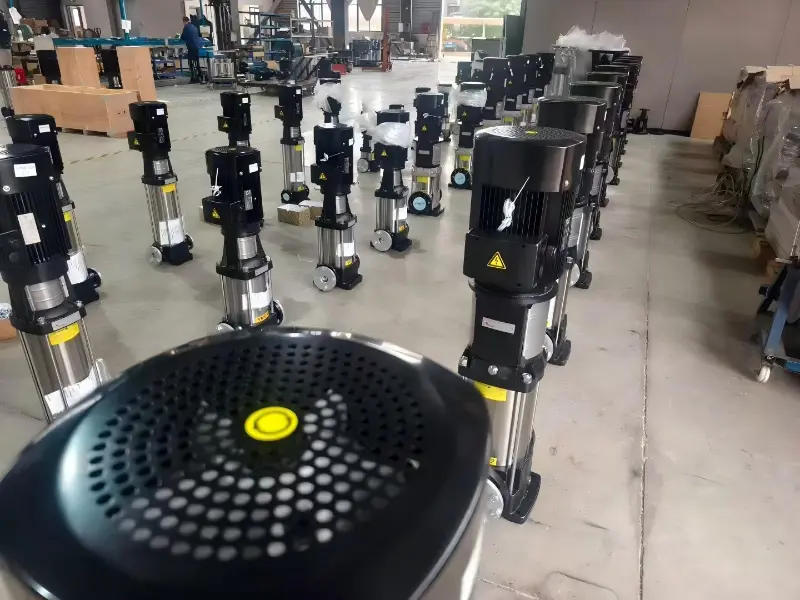
Working Principle and Process of Multistage Centrifugal Pumps
When the impeller of a multistage centrifugal pump rotates counterclockwise, the liquid inside is propelled outward by the impeller blades. Under the action of centrifugal force, a closed annular ring matching the shape of the pump casing is formed. The lower part of this ring is precisely tangent to the impeller hub, while its upper part makes contact with the blade tips. This creates a crescent-shaped space between the impeller hub and the liquid ring, which is further divided by the impeller blades into a series of small chambers equal in number to the blades.
Taking the bottom point (0°) of the impeller as the starting position, during the first 180° of rotation, the volume of each small chamber gradually increases. While expanding, the chamber connects with the suction port on the end face, allowing gas to be drawn in. Once suction is complete, the chamber isolates from the suction port. As the impeller continues to rotate, the volume of the chamber decreases, compressing the trapped gas. Finally, when the chamber aligns with the discharge port, the compressed gas is expelled from the pump.