
How Industrial Water Pumps Work
Kinetic Energy Transfer: From Mechanical Motion to Fluid PressureAt its essence, the working principle of an industrial water pump revolves around converting mechanical energy into hydraulic energy. This conversion occurs in sequential stages, each of which is vital to the pump’s ability to drive water through a system.The process starts with a power source—usually an electric motor or diesel engine—that drives a rotating shaft. This rotation generates mechanical kinetic energy, which is then transmitted to a pumping component, such as an impeller (in centrifugal pumps) or a piston (in positive displacement pumps). The movement of these components accelerates the fluid contained within the pump chamber.As the fluid gains velocity, its kinetic energy increases. In a well-designed pump system, this motion is redirected or constrained to convert the kinetic energy into hydraulic pressure. The end result is a pressurized flow of water, ready to be transported through pipelines, industrial systems, or storage tanks.The efficiency of this energy conversion depends on factors such as the pump type, its internal design, and the resistance from the downstream system. Regardless of variations in design or application, every industrial water pump adheres to this fundamental process of transforming mechanical motion into usable water pressure.
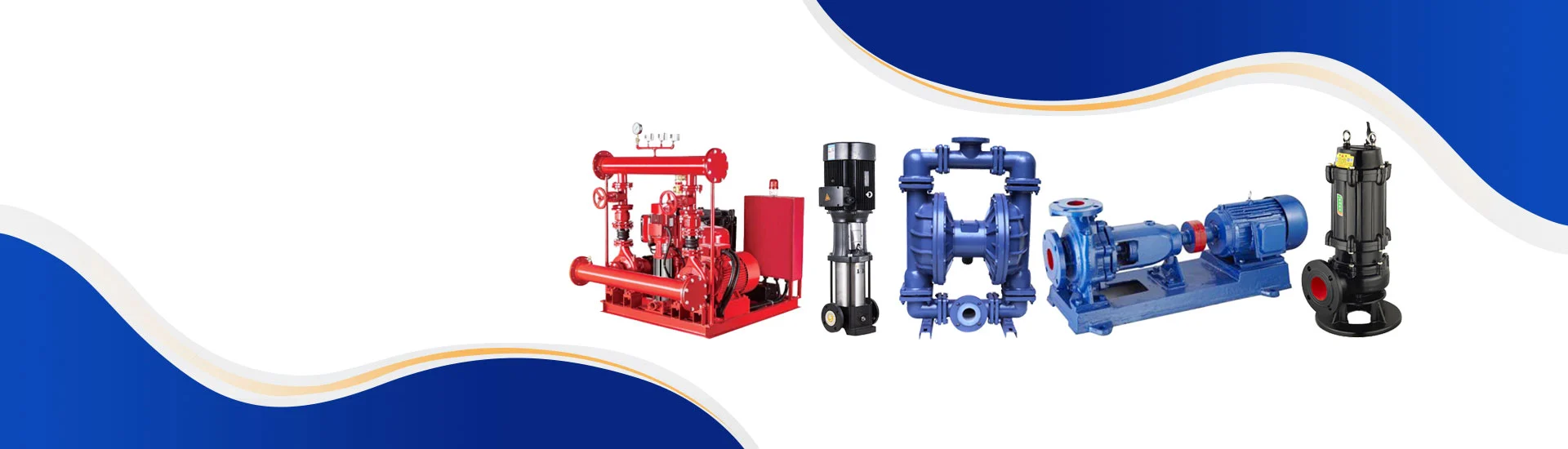
Centrifugal vs. Positive Displacement: Two Core MechanismsWhen exploring how industrial water pumps work, it is essential to understand the two primary categories: centrifugal pumps and positive displacement pumps. Each employs a unique method to generate flow and pressure, making them suitable for distinct industrial applications.Centrifugal PumpsCentrifugal pumps are the most widely utilized type in industrial environments. These pumps use a rotating impeller to transfer energy to the liquid. As the impeller spins at high speed, it draws water into the center of the pump casing. The fluid then moves outward through the impeller vanes due to centrifugal force, undergoing acceleration in the process.This increase in velocity is subsequently converted into pressure by the volute casing or diffuser. The smooth, continuous motion of centrifugal pumps makes them ideal for transferring large volumes of water at moderate pressures. However, they are less effective when handling viscous liquids or operating in systems that require constant flow under varying pressure conditions.A key characteristic of centrifugal pumps is their reliance on dynamic flow. They require priming before operation and perform best in systems where pressure fluctuations are minimal. While their working principle is relatively straightforward, they are highly efficient for pumping clean water and low-viscosity fluids.Positive Displacement PumpsIn contrast, positive displacement (PD) pumps trap a fixed volume of fluid and force it through the system with each operational cycle. Common types of PD pumps include piston, diaphragm, gear, and screw pumps.For instance, a piston pump operates by drawing fluid into a chamber during the intake stroke and then pushing it out during the discharge stroke. This mechanism creates a constant, metered flow, regardless of pressure variations in the system. The mechanical precision of these pumps enables them to handle high-viscosity or abrasive fluids with high accuracy.Unlike centrifugal pumps, PD pumps do not depend on velocity; instead, they function based on volume transfer. This makes them ideal for applications such as dosing, chemical processing, or any scenario that requires precise flow control. Their working principle allows them to generate high pressures with lower flow rates, and they often come equipped with pressure relief valves to protect the system from overpressure.How Submersible and Multistage Pumps WorkBeyond the two major categories, there are specialized pump types designed for specific environments. Two commonly used variants are submersible pumps and multistage pumps—each with unique working principles tailored to their intended purpose.Submersible PumpsSubmersible pumps are engineered to operate while fully submerged in the fluid they are pumping. The motor is enclosed in a watertight housing to prevent fluid ingress. These pumps utilize the same basic principle as centrifugal pumps but are integrated into a single sealed unit, allowing them to operate in wells, tanks, or flooded areas.The impeller, located inside the submerged housing, spins to accelerate water and push it upward through a discharge pipe.
Since the entire unit is underwater, priming is unnecessary, and suction head limitations are eliminated. Submersible pumps are highly efficient for deep well pumping, wastewater lifting, and drainage systems.Their unique design reduces the risk of cavitation and supports vertical lifting without the need for external mechanical drives or suction lines. While their working principle remains based on kinetic energy transfer, it benefits significantly from the pump’s submerged position within the fluid.Multistage PumpsMultistage pumps operate by combining multiple impellers in series, with each stage progressively increasing the fluid’s pressure.
Water enters the first stage, where it is accelerated and pressurized, then flows into the next impeller, where the process repeats. This design enables the generation of high pressure even when using relatively compact motors.The working principle of a multistage pump is essentially that of a centrifugal pump, but multiplied to achieve greater output. These pumps are ideal for boiler feed applications, reverse osmosis systems, and high-rise building water supply—scenarios where consistent high pressure is required over long vertical or horizontal distances.Each stage operates on the same kinetic principle but adds incremental energy, resulting in a significantly elevated output pressure.
Careful engineering is required to ensure balanced axial loads and minimize energy losses between stages.ConclusionA solid understanding of the industrial water pump working principle enables users to do more than just operate a system—it empowers them to maintain, troubleshoot, and optimize it effectively. Whether dealing with the dynamic flow of centrifugal pumps or the precision of positive displacement pumps, grasping how energy transforms into pressure and motion provides a critical advantage in managing pump performance.Specialized pumps such as submersible or multistage variants follow the same core energy conversion logic but feature unique mechanical adaptations to suit their specific applications. Selecting the right pump begins with understanding how it works—not just where it can be applied.At Crownspump, we specialize in delivering precision-engineered pump systems that align operational demands with mechanical integrity. Our team can help you select and maintain the right pump by explaining not just what it does—but how it works. Contact us today to learn more about our high-efficiency pump technologies and expert support services.